|


Product Highlights
- Full wave EM solver accounts for full dispersion and radiation.
- Quasi-static EM solver for faster modeling of larger circuits from DC to a half wavelength.
- Fully-integrated with ADS Layout environment.
- "Edge mesh" for improved behavioral characterization of current crowding in high frequency signals.
- Adaptive frequency sampling (AFS) provides the greatest frequency sweep resolution with a minimal number of actual solved frequencies.
- Available sidewalls simulation (waveguide mode) to model the effects of placing a circuit near a package sidewall.
- Incorporates box resonance mode to model package effects and discover if box resonance occurs anywhere in the frequency range of interest.
- Generates the DC operating point with S-parameters for circuit simulations that need bias flowing to an active device.
- Fully automated EM design optimization with Momentum Optimization add-on.
- 3D visualization and current animation capabilities with Momentum Visualization add-on.
Product Description
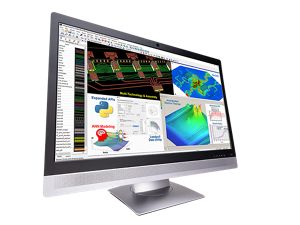
Momentum is a 3-D planar electromagnetic (EM) simulator that enables RF and microwave designers to significantly expand the range and accuracy of their passive circuits and circuit models. The ability to analyze arbitrary shapes, on multiple layers and to consider real-world design geometries when simulating coupling and parasitic effects, makes Momentum an indispensable tool for customized passive circuit design.
Momentum works together with Advanced Design System (ADS) to compute S-, Y-, and Z-parameters of general planar circuits. Microstrip, stripline, slotline, coplanar waveguide, and other circuit topologies can be analyzed quickly and accurately with Momentum. Vias that connect one layer to another can also be simulated; enabling design engineers to more fully and accurately simulate multilayer RF/MMIC's, printed circuit boards, hybrids, and Multi-Chip Modules (MCMs).

The simulator is based on the Method of Moments (MoM) technology that is particularly efficient for analyzing planar conductor and resistor geometries. It is designed to evaluate multi-layer planar geometries and generate EM accurate models that can then be used directly in ADS circuit simulators including Harmonic Balance, Convolution, and Circuit Envelope.
Circuit simulators must explicitly account for signal coupling and are also limited to designs that can be constructed only from available circuit models. The Momentum EM simulator overcomes the limitations of available models by implicitly accounting for signal coupling.
Momentum RF is a second simulation mode designed to increase simulation speed without sacrificing accuracy. The large geometries, so important to the communications industry, are quickly and easily solved with Momentum RF.
Structures under a half wavelength are particularly well suited for analysis with Momentum RF. The quasi-static solver in Momentum RF makes it possible to neglect loss mechanisms such as space and substrate radiation, providing accurate results in a fraction of the time.
Click on the following links for more information about Momentum RF:
Key Features and Benefits
Momentum 3-D planar EM design tools come with a list of impressive features. The following key technological enablers demonstrate the advantages of Momentum as a planar EM design tool:
Momentum EM Simulator
E8925A Momentum Optimizer
E8922A Momentum Visualization
When to Use Momentum 3-D Planar EM Simulator
Momentum 3-D planar EM modeling is especially valuable in the following design situations:
When Parasitic Coupling is Present. Even when circuit models are physically far apart, unexpected coupling can take place. Examples include stubs that seem sufficiently separated, but are actually inductively couple to each other because of a resonance condition, and surface waves that are bound to substrate interfaces and are excited when the right substrate parameters and frequencies are present. Momentum predicts the parasitic coupling and radiation.
When a Circuit Model Does Not Exist. Momentum should be used when a circuit model does not exist. For example, if a designer wants to analyze a microstrip Y-junction for which there is no model, Momentum is the solution.
When There are Slots in Ground Planes. Designers remove portions of ground planes for a variety of reasons, such as reducing the capacitance to ground of a spiral inductor, or to allow a via to pass through a ground plane. Momentum's ability to treat metal slots as easily as metal patterns is an added advantage. For example, Momentum performs efficient analysis of coplanar waveguide circuits.
When the Model Range is Exceeded. All circuit simulator models are developed with a number of range limited control parameters, (such as width, length, height, or dielectric constant,). Some models break down gradually, while others generate significant errors as soon as the range limits are exceeded. Momentum allows designers to generate highly accurate models beyond these built-in range limits.


How To Buy
To request immediate sales assistance - for help choosing the best system; for product configuration and integration details; to request telephone assistance or an on-site demo of the software; or to request a price quotation - click on the following link:
For sales assistance by telephone, click on the following link for the telephone numbers in your area:
Configuration Details
Momentum Product Suites
E8920A Product Bundle offers Momentum full-wave and quasi-static modeling engines (Momentum E8921A) as well as Momentum Optimization E8925A, and Momentum Visualization E8925A.
E8811A/8812A MMIC Designer Pro/Premier is a front-to-back design solution that incorporates EM modeling including Momentum full-wave and quasi-static modeling engines (Momentum E8921A) as well as Momentum Optimization E8925A, and Momentum Visualization E8925A.
Required
Add-On Modules
For More Information ...
Additional configuration details are available online in the following sources:


- Momentum (PDF, 4.0 MB)
12-page color product overview.


Advances in the current release of Momentum include the following:
- Momentum in ADS 2008 now takes advantage of multi-core processors in modern computers to speed up simulation by at least a factor of 2. This is done by parallel loading of the solution matrix into memory through the multi-processors. Since 2004, Momentum simulation speed has been increased 10x through algorithmic improvement and parallel computation.

- E8917 Gerber Union - a layout translation tool that converts Gerber files, by performing a union operation on strikes, flashes, and areas, into clean layout artwork for electromagnetic (EM) analysis by the Momentum 3D-planar EM design and verification tool.
- Momentum - 64-bit solver
Advances in previous product releases include the following:
- Momentum Integration with RFDE and Cadence Virtuoso
- Advanced Model Composer for fast, transparent EM verification at the component level
- Batch mode for Momentum simulations
- Improved substrate calculations for more efficient simulations
- Layout Components for transparent Momentum integration at the schematic design level
- Port calibration in Momentum RF
- CPW characteristic impedance calculations at the strip level
For More Information ...


Articles
- Youri Tretiakov, IBM Microelectronics, et al., Improved Modeling Accuracy of Thick Metal Passive SiGe/BiCMOS Components for UWB Using ADS Momentum, Microwave Product Digest, October 2004. Current issue: Microwave Product Digest.
- Mounir Adada, Tom Dhaene, Agilent EEsof EDA, Advanced Model Composer: Empowering Designers with Speed and Accuracy, Microwave Product Digest, April 2004. Current issue: Microwave Product Digest.
- Mounir Adada, Agilent Technologies, Practical Approaches to Faster, More Accurate MMIC Design, Microwave Product Digest, October 2003. Current issue: Microwave Product Digest.
- Jan Kahdeman, Agilent Technologies, Meeting the modeling challenges of high-frequency designs, Electronic Products, 10 August 2003. Current issue: Electronic Products.
- Mounir Adada, Agilent Technologies, Layout Components - The New EDA Building Blocks for Physical Design Modeling, Microwave Product Digest, October 2002. Current Issue: Microwave Product Digest.
- Martin P. Wilson, Tality, Modelling of integrated VCO resonators using Momentum (PDF, 170 KB). 3-page technical paper.
- Martin P. Wilson, Tality, Modelling of integrated VCO resonators using Momentum (PDF, 610 KB). 48 slides.
- Laurent Vantrepol, et al., Design Methodology for Microwave Coupled Line Filters Based on Agilent Advanced Design System (PDF, 213 KB). 4-page technical paper. For additional details, contact: Frank Berthaux, Agilent Technologies.
- Chris Mueth, Using Ball Grid Array Packaging in Wireless IC Designs (PDF, 340 KB), Agilent R & D Insight, Volume 1, Number 6, 2001.
- Russ Kramer, CMOS VCSEL Driver Design at 1Gbits/s for High-Speed Optical Communication Applications, TechOnLine [registration required], 2001. PDF Version (PDF file, 140 KB). Current issue: Tech OnLine.
- Jan Van Hese, Agilent Technologies, Design and Simulation of Spiral Inductors on Silicon Substrates, ChipCenter, 17 December 2001. PDF version of published paper (123 KB). Current Issue: ChipCenter.
- Mounir Adada, Best of Both Worlds: New Modeling Technology Combines EM Accuracy With the Speed of Analytical Models, Microwave Product Digest, December 2001. PDF Version (PDF file, 175 KB). Current issue: Microwave Product Digest.
- Jim DeLap, Planar EM Simulation of Multi-chip Modules and BGA Packages, Communication Systems Design, November 2001. Current issue: Microwave Journal.
- Agilent EEsof EDA, Inductance and Capacitance Modeling of RF Board and High Speed Package Interconnects based on Planar EM Simulation (PDF, 142 KB), 12-page technical paper.
- Agilent EEsof EDA Library


Seminar Archive
- Momentum Seminar Archive - PDF files of slides, ADS project files, and other materials supporting a one-day customer seminar covering key topics in Momentum set-up and simulation. Also includes information on using Advanced Model Composer.
Customer Education
Momentum for Advanced Design System Users
This one-day class is a medium-paced detailed review of the 3-D electromagnetic simulator Momentum. A number of designs are used to illustrate how the various simulation techniques may be effectively employed in a real-world situation.
For detailed course descriptions and class schedules worldwide, click on the following link:
Product Documentation
|